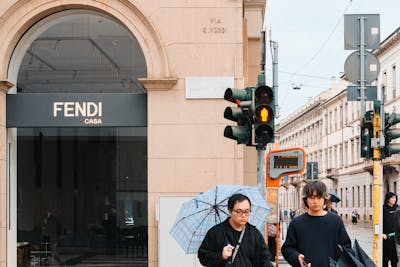
In the landscape of Italian luxury fashion, Fendi occupies a position of singular historical significance. The Roman house — founded in 1925 by Adele and Edoardo Fendi as a fur and leather goods workshop — was transformed across five decades of collaboration with Karl Lagerfeld into one of the most technically inventive and most commercially successful luxury brands in the world. In 2026, under the creative direction of Kim Jones for womenswear and Silvia Venturini Fendi for accessories and menswear, the house continues to produce work of extraordinary craft quality and extraordinary cultural relevance.
The Fendi Heritage
Adele Fendi founded her fur and leather goods workshop on the Via del Plebiscito in Rome in 1925, establishing a reputation for exceptional craft quality that attracted a loyal clientele of Roman society women. The business expanded under her five daughters — Paola, Anna, Franca, Carla and Alda — who brought both commercial discipline and creative ambition to the house’s development in the post-war decades.
Karl Lagerfeld’s appointment as Creative Director in 1965 — a collaboration that would last until his death in 2019 — transformed Fendi from a respected Roman craft house into a global luxury brand of the first order. Lagerfeld’s irreverence toward the fur tradition — his famous declaration that fur should be treated like cotton — produced collections of extraordinary creativity that challenged every convention of the luxury fur market while establishing Fendi’s technical mastery as a benchmark for the industry.
The Double F
The Fendi Double F monogram — created by Karl Lagerfeld in 1965 as a pattern for the house’s fur linings — became one of luxury fashion’s most recognisable logos and the foundation of one of the most commercially successful accessory programmes in the industry. Applied to the Baguette, the Peekaboo and dozens of other bag designs across generations of collections, the Double F has accumulated the kind of cultural authority that only decades of consistent quality and creative application can produce.
The Baguette
The Fendi Baguette — introduced in 1997 by Silvia Venturini Fendi and named for the way it is carried under the arm like a French bread — is one of the most significant handbag designs in the history of luxury fashion. The small, structured bag with its FF clasp and its extraordinary range of materials and embellishments created a new category of luxury accessory — the collectible bag — and established the template for the limited edition bag drops that now define the luxury accessories market.
The Baguette’s cultural significance was amplified by its prominent role in Sex and the City — where Sarah Jessica Parker’s character Carrie Bradshaw carried it in multiple episodes — and its status has only grown in the decades since. The secondary market for exceptional Baguette configurations — rare embroideries, exotic skins, artist collaborations — is among the most active and most closely followed in the luxury accessories world.
The Peekaboo
The Fendi Peekaboo — introduced in 2009 and named for the way its interior is revealed when the bag is opened — is the house’s definitive contemporary bag and one of the strongest investment propositions in the luxury accessories market. The structured silhouette, the exceptional leather quality and the wide range of configurations — from the standard size to the mini and the ISeeU variations — have created a family of pieces of extraordinary collecting depth.
The Peekaboo’s combination of exceptional craft quality, the house’s Roman heritage and a design of genuine architectural intelligence places it alongside the Birkin, the Kelly and the Classic Flap as one of the defining luxury handbag investments of the contemporary market.
The Kim Jones Era
Kim Jones’s appointment as Artistic Director of Fendi womenswear in 2020 — combining his role with his ongoing Creative Director position at Dior Men — represented one of the most significant appointments in the luxury fashion industry in recent years. Jones’s approach at Fendi, which brings his characteristic references to art, culture and the history of fashion to the house’s Roman heritage, has produced collections of considerable sophistication and genuine collector interest.
The collaboration with artists and cultural figures that has characterised Jones’s tenure — including the extraordinary Fendi x Versace exchange and the ongoing engagement with contemporary art — reflects both his personal creative vision and Fendi’s long tradition of cultural engagement.
The Verdict
Fendi in 2026 is the luxury fashion house for the buyer who values the intersection of exceptional craft, extraordinary accessory design and the cultural depth of a Roman house with a century of history. The Baguette’s iconic status, the Peekaboo’s investment credentials and Kim Jones’s creative ambition make it one of the most compelling and most historically significant propositions in the Italian luxury market.
Explore Fendi’s current collections and discover Roman luxury fashion at its most technically inventive and most culturally engaged.
DE: Dieser Beitrag enthält Affiliate-Links. Wenn Sie über diese Links kaufen, erhalten wir eine Provision – für Sie entstehen keine Mehrkosten.
EN: This post contains affiliate links. We may earn a commission if you purchase through these links, at no extra cost to you.