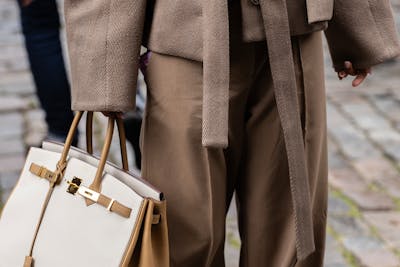
In the world of luxury collecting, no single object generates more discussion, more desire and more secondary market activity than the Hermès Birkin. The structured tote that Hermès created in 1984 following a chance encounter between Jane Birkin and Jean-Louis Dumas — and that has since become the most valuable handbag in the world, the most reliable luxury investment asset and the single most recognisable symbol of extreme wealth and taste — occupies a position in the luxury landscape that no other object can credibly claim.
In 2026, with secondary market prices that continue to outperform gold, equities and most alternative investment categories, the Birkin’s status as both a wearable luxury object and a serious financial asset has never been more clearly established.
The History of the Birkin
The Birkin’s origin story is one of the great founding myths of luxury fashion. In 1981, actress and singer Jane Birkin was seated next to Hermès CEO Jean-Louis Dumas on a flight from Paris to London. During the flight, the contents of her straw basket fell into the aisle, prompting a conversation about the difficulty of finding a practical yet elegant leather travel bag. Dumas sketched a bag on an airline sickness bag during the flight — and the Birkin was born.
The first Birkin was delivered to Jane Birkin in 1984, produced by a single Hermès artisan in the Saint-Louis workshop. The bag’s combination of the structured silhouette, the double flap closure, the padlock and keys and the exceptional leather quality created an object of such completeness that it has remained in continuous production for over forty years without fundamental structural change.
Understanding the Birkin
The Hermès Birkin is produced in a range of sizes, leathers, colours and hardware configurations that create a matrix of collecting possibilities of extraordinary depth. Understanding the key variables is essential for the collector who wants to navigate the Birkin market intelligently.
The sizes — 25cm, 30cm, 35cm and 40cm, plus the miniature 20cm and the oversized 45cm and 50cm travel configurations — each have their own collector following and their own secondary market dynamics. The 25cm and 30cm are the most sought-after sizes for everyday carrying, with the 30cm typically commanding the strongest secondary market performance due to its combination of practicality and visual presence.
The leathers — Togo, Clemence, Epsom, Swift, Chevre and the exotic skins including Niloticus Crocodile, Alligator, Ostrich and Lizard — each have their own tactile qualities, their own durability characteristics and their own price dynamics. The exotic skin Birkins — particularly the Niloticus Crocodile configurations — command prices that can exceed one hundred times the retail price of a standard leather Birkin, and the most exceptional examples have achieved auction records that place them among the most valuable personal property ever sold.
The Investment Case
The Hermès Birkin’s investment credentials are the most thoroughly documented of any luxury object category. Research published by asset management firms consistently shows that Birkin bags have outperformed both gold and the S&P 500 as investment assets over extended periods — a finding that has attracted institutional attention and driven significant capital into the secondary market.
The most reliable investment configurations are those that combine size, leather and colour combinations of enduring desirability with excellent condition and complete provenance documentation. The classic leathers — Togo and Clemence in neutral colours, particularly black, gold and Etain — provide the most liquid secondary market performance, while the exotic skin configurations offer the potential for extraordinary appreciation at the cost of a significantly higher acquisition price.
The hardware — gold hardware, palladium hardware and the brushed palladium of the Ghillies configuration — adds a dimension of collecting complexity that significantly influences secondary market values. Gold hardware Birkins in classic leathers consistently command premiums over equivalent palladium hardware configurations, reflecting both aesthetic preference and the historical association of gold hardware with the earliest and most significant Birkin production.
Accessing the Birkin
The Hermès Birkin is not available for direct purchase at retail in the conventional sense. The house’s policy of offering Birkins only to established clients with a purchase history at Hermès — and of limiting the number of Birkins available to any individual client in a given period — creates a controlled scarcity that supports secondary market values and ensures that the experience of acquiring a new Birkin from Hermès remains one of the most coveted transactions in luxury retail.
For collectors who want to acquire a Birkin without the time investment of building an Hermès client relationship, the secondary market — through reputable resellers including Vestiaire Collective, The RealReal and specialist Hermès resellers — provides access to the full range of configurations at prices that reflect the genuine demand for the most sought-after pieces.
Authenticating a Birkin
The authentication of Hermès Birkins — essential for any secondary market purchase — requires knowledge of the specific construction details, stampings and hardware characteristics that distinguish genuine Hermès production from the extraordinary range of counterfeit goods that the Birkin’s desirability has generated.
The blind stamp — the single letter or letter-number combination stamped inside the bag that indicates the year of production — is one of the most important authentication details. The craftsman’s stamp, the hardware engravings and the specific characteristics of the stitching, leather and hardware that vary across production periods all contribute to the authentication picture.
For significant secondary market purchases, authentication by a specialist service — including the Hermès authentication programme available at some Hermès boutiques — provides the assurance that the investment warrants.
The Verdict
The Hermès Birkin in 2026 remains what it has always been: the most coveted luxury object in the world and the most reliable luxury investment asset available to the private collector. For the collector who wants a single object that combines wearable beauty, cultural significance and financial performance, the Birkin is, simply, the answer.
Explore the world of Hermès Birkin collecting and discover why the world’s most valuable handbag remains the ultimate luxury investment.
DE: Dieser Beitrag enthält Affiliate-Links. Wenn Sie über diese Links kaufen, erhalten wir eine Provision – für Sie entstehen keine Mehrkosten.
EN: This post contains affiliate links. We may earn a commission if you purchase through these links, at no extra cost to you.